
Basic Policy
Basic Policy on Corporate Governance
(1) Basic Approach
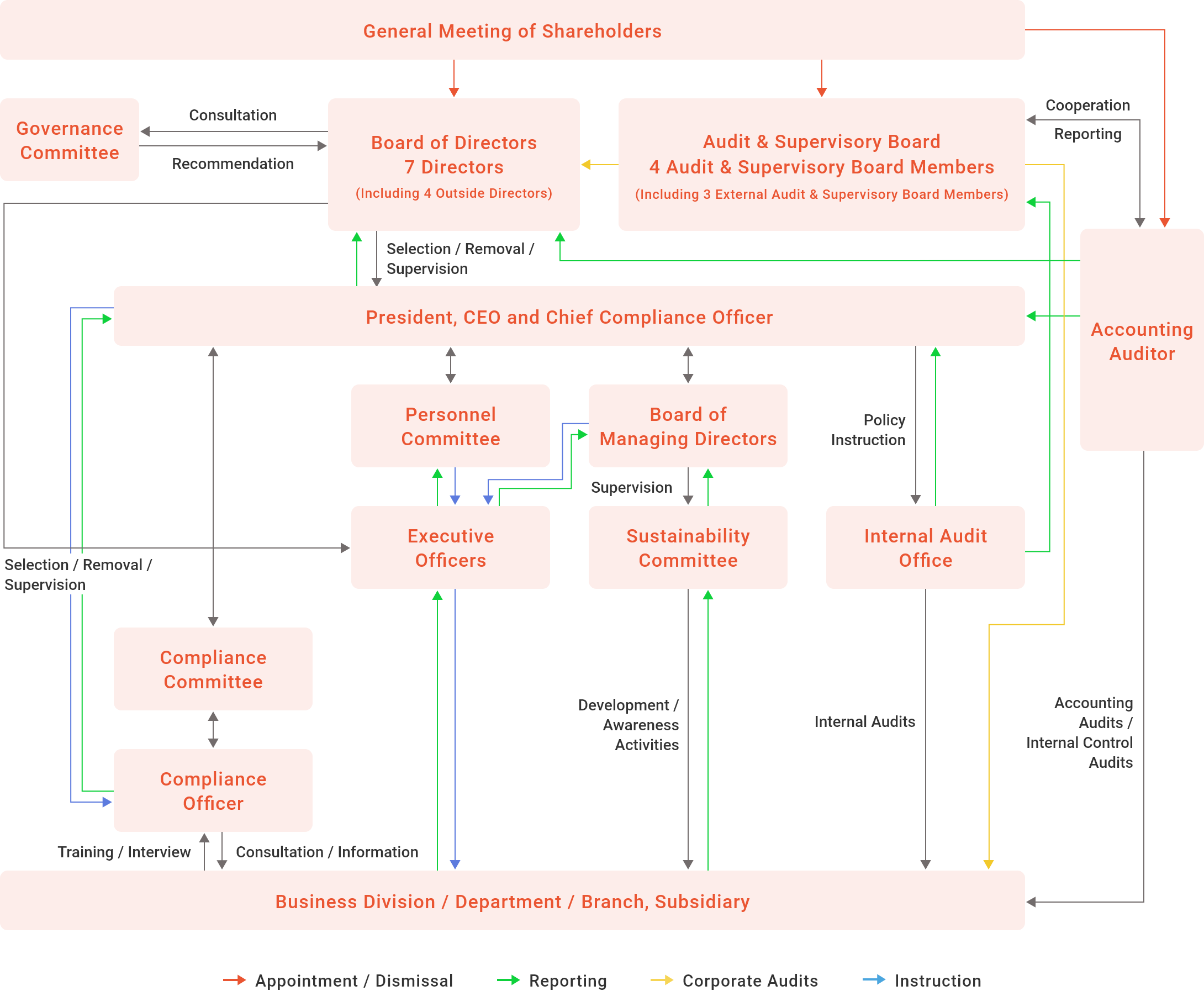
Our company's basic policy is to ensure transparency and soundness in management and improve efficiency. We believe that strengthening the Board of Directors and the Board of Corporate Auditors, enhancing the function of preventing illegal acts, disclosure, and the obligation to explain to shareholders are important, and we are working to improve corporate governance. To achieve this, our company has adopted the structure of a company with a Board of Corporate Auditors, and by appointing outside directors and outside corporate auditors who meet the requirements for independent officers, we are strengthening the management oversight function, and we have also introduced an executive officer system to expedite and streamline decision-making and business execution.
(2) Corporate Governance System
Our group consists of our company and one subsidiary, and we are undertaking corporate governance initiatives on a group basis.
Corporate governance framework
Corporate Governance Report
Effectiveness Assessment of the Board of Directors
(1)Analysis and Evaluation Process
To evaluate the effectiveness of the Board of Directors, we conducted an analysis and evaluation of its effectiveness by obtaining third-party expertise and conducting a self-assessment by surveying all directors and auditors.
(2)Summary of Evaluation Results
The evaluation results confirmed that the effectiveness of the Board of Directors is ensured. Strengths identified included a board composition that considers necessary skills and qualities, active discussion management supported by prior materials and explanations, disclosure, enhanced IR/SR activities, and strengthened executive training based on past survey results. On the other hand, challenges were identified for further improvement, including diversification of personnel selection, including the appointment of individuals from business companies and foreign nationals, consideration of the nature of dialogue between outside directors and shareholders, and the implementation and review of planned and continuous executive training. We will continue to strive for further improvement of the Board of Directors' functions through a board composition that considers necessary skills and qualities and active discussion management.
Summary of the Information Disclosure System
The Company conducts information disclosure as follows.
1.Types of disclosed information
The Company discloses facts and decisions required to be disclosed in a timely manner by the Tokyo Stock Exchange (hereinafter, “timely disclosure information”), information disclosed under the Companies Act and the Financial Instruments and Exchange Act, and other similar information in compliance with the following principles.
2.Basic disclosure policy
We strive to ensure timely and accurate disclosure of information to all stakeholders, including shareholders and investors, in line with our commitment to transparency, fairness, and continuity. The information disclosed includes both the financial data, such as the Company’s financial position, operating results, and the non-financial data, such as information about management strategy and management issues, risks, and corporate governance.
3.Disclosure System
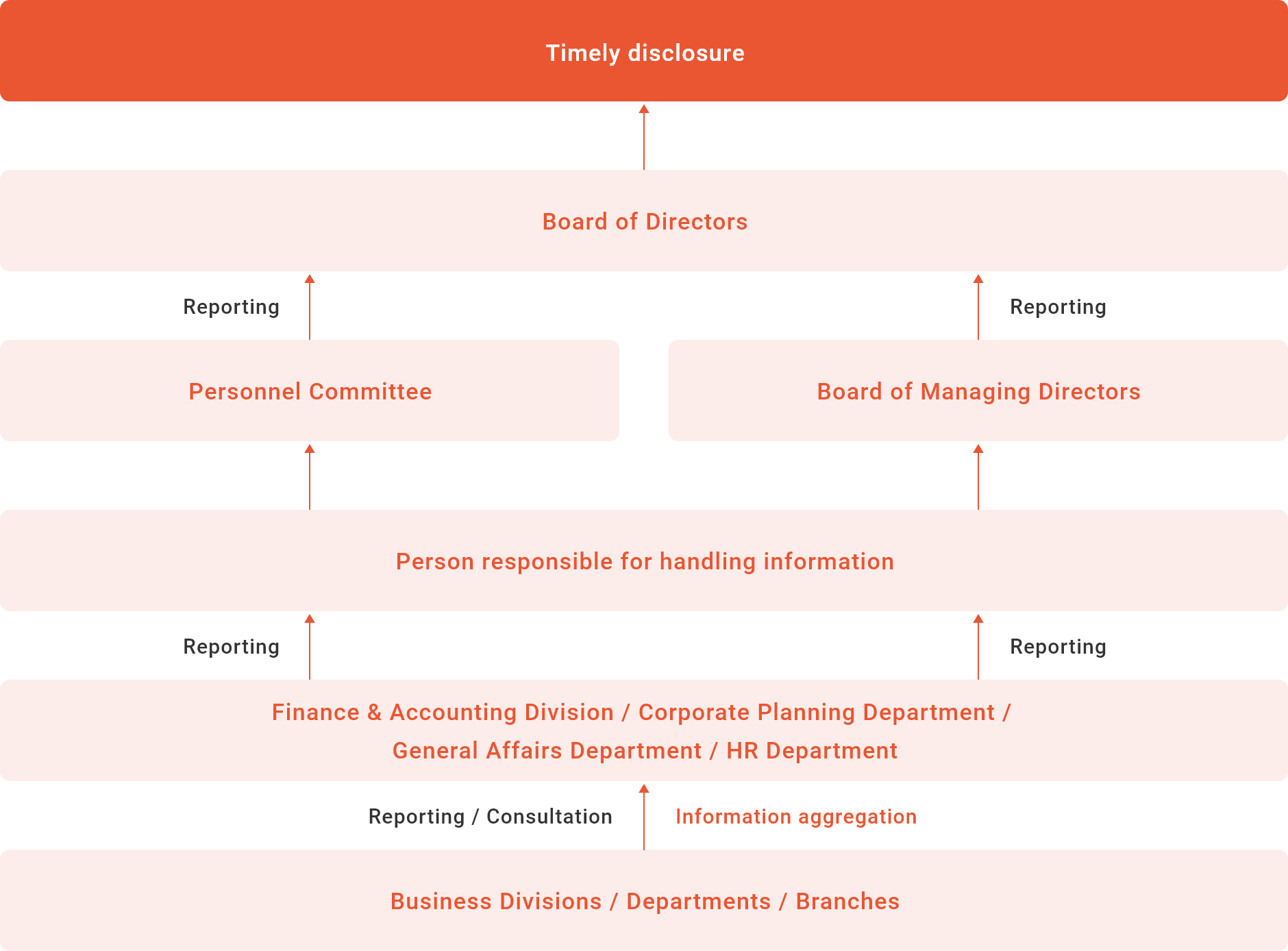
The Company’s internal system regarding information disclosure is as follows.
Timely disclosure structure
(a)Timely disclosure
The Chief Financial Officer (CFO) is responsible for the handling of information, while the Finance & Accounting Division (Accounting Department) acts as our contact point for timely disclosure. We are constantly working to raise awareness of the importance of timely disclosure within the Kanro organization. We have also established a system that allows officers and employees to report to the Accounting Department immediately and seek advice about any events or decisions in the organizations to which they belong that are seen as likely to have a significant impact on decisions by investors. Decisions by the Board of Directors, Board of Managing Directors, and Personnel Committee are reported directly to the CFO. Information about events occurring in corporate headquarters, plants, or other offices is aggregated by the Corporate Planning Department, General Affairs Department, HR Department and Accounting Department and reported to the CFO. The CFO then determines whether timely disclosure is required and implements the necessary disclosure measures after consulting within the Company.
(b)Important information other than timely disclosure information, as stipulated in laws and regulations, etc.
The units responsible for such information implement disclosure as required by laws, regulations, and rules, after consultation and deliberations involving other related units, and after deliberations within the Company about the appropriateness of the information to be disclosed.